Hotline: +420 599 509 599

International business: +420 556 621 020, sales@sectron.cz

WiFi Routers

(15)

High-Performance WiFi Router: The key to fast and stable internet for industrial and corporate environments

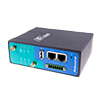
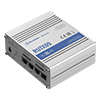
Do you need a stable and fast wireless connection even in demanding industrial conditions? An industrial WiFi router ensures secure and robust data transmission for all devices in your company, from IoT sensors and camera systems to smart control units and remote management.

Why choose an industrial WiFi router for demanding environments?

Unlike standard office models, an industrial router is designed for continuous operation (24/7) in extreme environments. It offers high-level security, advanced networking features ('>VPN, firewall), and high mechanical durability.

Key benefits of industrial wireless routers:

  • High durability: The construction withstands dust, moisture, vibrations, and extreme temperature fluctuations.
  • Mounting flexibility: Easy installation into switchboards on a DIN rail or on a wall.
  • Wide connectivity: Support for serial lines (RS232/RS485), Ethernet ports, and LTE/5G mobile networks.
  • Stability and redundancy: Automatic switching between WiFi, a fixed connection, and a SIM card in the event of an outage.

Flexible solutions also include portable mobile hotspots, which create a reliable Wi-Fi network directly in the field, on construction sites, or during mobile operations.

How does an industrial WiFi router work?

An industrial WiFi router combines the functions of a router and a wireless access point. It ensures a reliable connection of the local network (LAN/WLAN) with higher-level systems or the internet. It allows for both wireless and wired connections of a wide range of devices, from industrial sensors and PLCs to company computers or control panels. This facilitates real-time data collection, cloud communication, and remote service.

2.4 GHz vs. 5 GHz bands in industrial practice

Modern high-performance industrial routers operate in Dual-band mode (2.4 GHz and 5 GHz simultaneously):

  • 2.4 GHz band: Characterized by a longer range and better penetration through obstacles. It is ideal for connecting IoT sensors, barcode scanners, and measuring devices.
  • 5 GHz band: Offers high transmission speeds and lower interference. It is suitable for data-intensive applications such as video transmission from IP cameras, video conferences, or real-time cloud systems.

Sort of

Subcategories

Each WiFi router has its own standard that allows it to communicate in different communication bands. The real speed of the Internet then follows accordingly.
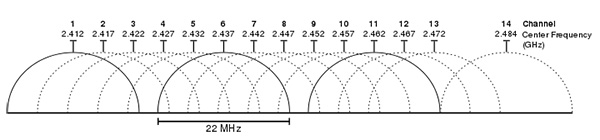
Channel distribution in the 2.4 GHz WiFi band

 WiFi standards and their designation:

• IEEE802.11a - max. Speed 54 Mbit / s, in the 5 GHz band
• IEEE802.11b - max speed 11 Mbit / s, in the 2.4 GHz band
• IEEE802.11g - max speed 54 Mbit / s, in the 2.4 GHz band
• IEEE802.11n - max. Speed 600 Mbit / s, in 2.4 and 5 GHz bands
• IEEE802.11ac - max speed 1000 Mbit / s, in the 5 GHz band

Offer WiFi routers

In our assortment, you will find WiFi routers which, in addition to the Ethernet input (the Internet is brought to the place by a cable to the Ethernet socket in the wall), also contain a cellular module and can obtain Internet from mobile networks of operators (Modem contains a SIM card slot). Due to its size, you can easily transport such a router between objects or create a WiFi network where there is no possibility of cable internet connection (for example, a weekend cottage).
ARSY line - creation of websites and e-shops